Tell us about the job
Takes about a minute. No obligation.
Sizing a furnace for Garrett County requires a contractor to account for a heating load that the equipment carries through the coldest stretch of the Appalachian year. Homes in Garrett County, MD run heat about nine months a year, from September through May. The burner, the heat exchanger, and the ignition system cycle repeatedly across that run, and components in an undersized or poorly sealed system accumulate stress that a shorter season would partly mask. A contractor quoting a new furnace here has to run a proper load calculation for the house as it stands, not pull a number from the old unit's nameplate, because an underbuilt install will not hide its shortcomings for long.
Existing ductwork is what a furnace installation turns on in this county. Half the homes in Garrett County, Maryland were built in 1982 or earlier (2020-2024 ACS 5-year). Equipment changes; the ducts laid when these houses were built were sized and routed for whatever ran in them at the time, and a new furnace draws air differently than what those ducts were designed around. A contractor assessing the job measures the existing trunk lines and return paths before anything else gets priced, because that assessment is what separates a straightforward swap from a job that requires duct modification to make the new system perform.
What Gets Installed With a New Furnace
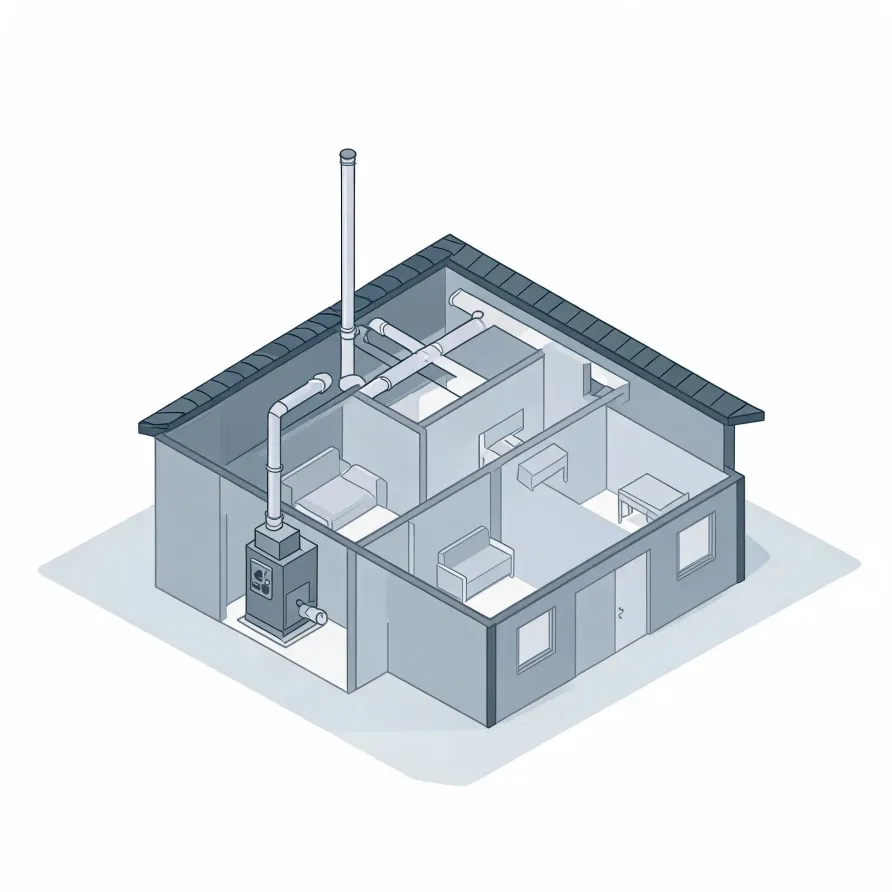
The furnace itself sits in a mechanical room, basement, or utility closet and burns fuel to produce heat. Attached to it is the heat exchanger, a metal chamber where combustion gases stay separated from the air that moves into your living space. The flue pipe runs from the furnace to an exterior wall or roof, carrying exhaust out of the house.
The blower motor sits inside the furnace cabinet and pushes conditioned air through the supply plenum, a sheet-metal box that connects the furnace to the duct system above or beside it. The thermostat mounts on an interior wall and acts as the control point, telling the furnace when to fire and when to stop.
The drawing shows a general layout of these components, and a licensed contractor determines exactly what applies to your home's configuration.
Get matched in Garrett CountyGarrett County by the numbers
74 severe weather events were recorded in Garrett County, Maryland between 2015 and 2024.
NOAA National Centers for Environmental Information, Storm Events Database, bulk CSV export, events 2015-01-01 through 2024-12-31.Half the homes in Garrett County, Maryland were built in 1982 or earlier (2020-2024 ACS 5-year).
U.S. Census Bureau, 2020-2024 American Community Survey 5-Year EstimatesGarrett County, Maryland holds 18,642 housing units (2020-2024 ACS 5-year).
U.S. Census Bureau, 2020-2024 American Community Survey 5-Year EstimatesOwners occupy 79.7% of the occupied homes in Garrett County, Maryland (2020-2024 ACS 5-year).
U.S. Census Bureau, 2020-2024 American Community Survey 5-Year EstimatesCodes & Standards for Furnace Installation in Garrett County, Maryland5 sourced rules and standards
What the installation looks like
Non-weatherized gas furnaces manufactured on or after November 19, 2015 must reach 80.0 percent AFUE.
Non-weatherized oil-fired furnaces manufactured on or after November 19, 2015 must reach 83.0 percent AFUE.
Mobile home gas furnaces manufactured on or after November 19, 2015 must reach 80.0 percent AFUE.
Non-weatherized gas furnaces manufactured on or after December 18, 2028 must reach 95.0 percent AFUE, up from the 80.0 percent minimum that applies to units manufactured before that date.
Licensing and Legal Requirements in Garrett County, Maryland
Maryland requires a state licence before an individual provides, or assists in providing, heating, ventilation, air-conditioning or refrigeration services.
Severe Weather Events in Garrett County
Garrett County's climate puts real demands on heating equipment, and those demands vary with what each year actually delivers. A furnace sized and installed for local conditions holds up better than one spec'd against a national average.
74 severe weather events, 2015–2024. Source: NOAA National Centers for Environmental Information, Storm Events Database.