
Tell us about the job
Takes about a minute. No obligation.
A furnace repair in Allegany County starts with the parts that cycle the most: the burner, the heat exchanger, and the ignition system. Homes in Allegany County, MD run heat about eight months a year, from October through May. Those components light, fire, and shut down repeatedly across that span, and the wear pattern a contractor finds in the heat exchanger or on the igniter reflects exactly that kind of accumulated load. A cracked heat exchanger or a failing ignition module here is less likely to be a fluke than the predictable result of a system that has been asked to do its job through most of the calendar year, season after season.
Furnaces running in prewar and early postwar houses have often outlasted the supply chains built around them. Half the homes in Allegany County, Maryland were built in 1959 or earlier (2020-2024 ACS 5-year). A contractor opening a furnace in stock this old has to price parts before the repair scope is settled, because a heat exchanger or control board from that era may take days to source, or may no longer be manufactured at all. What looks like a straightforward fix can stall on availability rather than on labor or access.
The Parts of a Furnace a Contractor Checks First
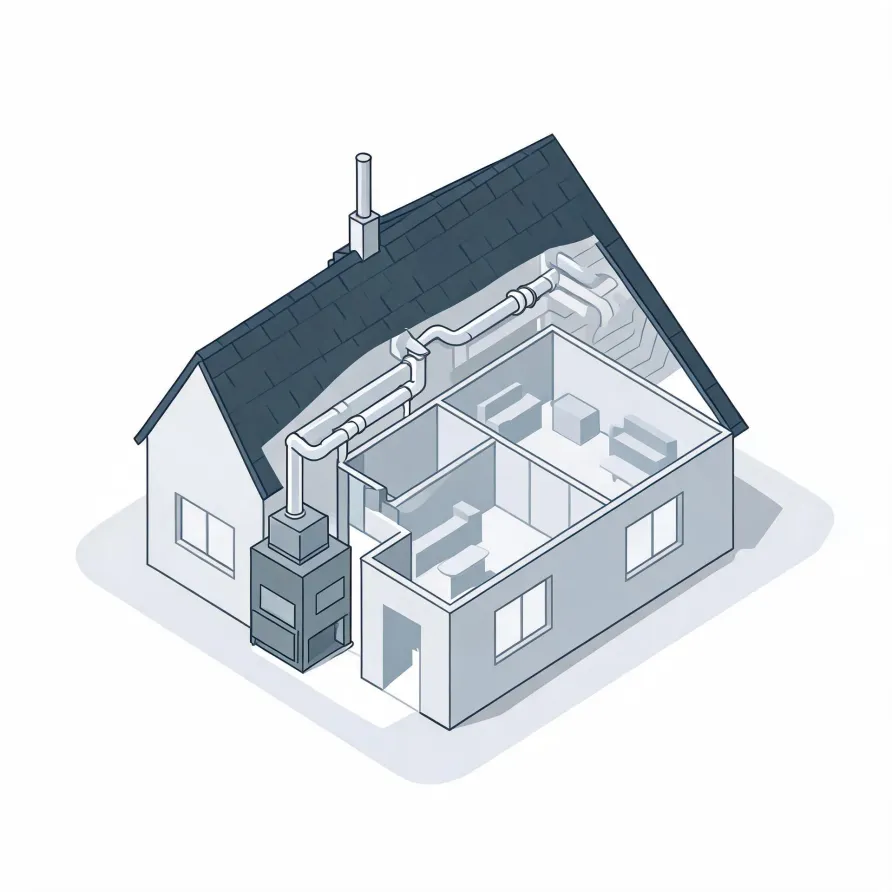
The furnace itself sits in a mechanical room, basement, or utility closet and is the piece a contractor opens first. Inside it, the heat exchanger is a frequent source of trouble: cracks in it let combustion gases into the air supply. The burners, which fire below the exchanger, get checked for uneven flame or buildup that disrupts ignition.
The blower motor sits at the base of the furnace cabinet and pushes conditioned air through the supply plenum into the duct system. Alongside it, the control board and the igniter are small components that carry the whole sequence of operation. When either fails, the furnace may run partially or not at all, so a contractor reads them early.
The drawing shows a general layout of the system, and a licensed contractor determines what applies to this particular house.
Get matched in Allegany CountyAllegany County, by the numbers
169 severe weather events were recorded in Allegany County, Maryland between 2015 and 2024.
NOAA National Centers for Environmental Information, Storm Events Database, bulk CSV export, events 2015-01-01 through 2024-12-31.Half the homes in Allegany County, Maryland were built in 1959 or earlier (2020-2024 ACS 5-year).
U.S. Census Bureau, 2020-2024 American Community Survey 5-Year EstimatesAllegany County, Maryland holds 32,720 housing units (2020-2024 ACS 5-year).
U.S. Census Bureau, 2020-2024 American Community Survey 5-Year EstimatesOwners occupy 70.7% of the occupied homes in Allegany County, Maryland (2020-2024 ACS 5-year).
U.S. Census Bureau, 2020-2024 American Community Survey 5-Year EstimatesRules & Standards Governing Furnace and HVAC Repair in Allegany County, Maryland5 sourced rules and standards
What HVAC Repair Looks Like in Allegany County
Non-weatherized gas furnaces manufactured on or after November 19, 2015 must reach 80.0 percent AFUE.
Non-weatherized oil-fired furnaces manufactured on or after November 19, 2015 must reach 83.0 percent AFUE.
Mobile home gas furnaces manufactured on or after November 19, 2015 must reach 80.0 percent AFUE.
Non-weatherized gas furnaces manufactured on or after December 18, 2028 must reach 95.0 percent AFUE, up from the 80.0 percent minimum that applies to units manufactured before that date.
Licensing and Legal Requirements in Allegany County, Maryland
Maryland requires a state licence before an individual provides, or assists in providing, heating, ventilation, air-conditioning or refrigeration services.
Severe Weather Events in Allegany County
Extreme weather puts real stress on furnace systems, pushing them harder and wearing parts faster. How often that happens in Allegany County shapes how much repair work the equipment around here actually needs.
169 severe weather events, 2015–2024. Source: NOAA National Centers for Environmental Information, Storm Events Database.